Thursday, April 14, 2016

Test-Run Coptic Stitch

With my upcoming class at KWHSS, I thought I'd better time how long it takes me to assemble a book using my pre-cut templates, to make sure we'll be able to finish a book in the 55 minute class limit.


Turns out that's a nope. It took about 1 hour from start to finish, with me already knowing the process. This book is 4.5" x 5.5", with five signatures. I'm going to have to trim time off by prepping more materials in advance, such as gluing the covers together (saves 10 minutes!), and possibly pre-folding all the signatures (groan), to allow time for explaining the process and giving students time to make mistakes and fix them. It's important to finish the book in the class because the final stitches are different, for attaching the cover.

I'm disappointed, but glad I did this so my class isn't a big fat fail. I also learned that my screw punch has issues and people are going to have to share hole punches for the covers. This should get interesting... (Anyone have a 1/16 or 1/8" hole punch they want to lend me for a day?)

I also need to remind myself to pick up more wide-mouthed needles and pencils. I am also now the proud owner of a ton of glue sticks that my students will no longer get to play with.

Monday, April 11, 2016

Awls

I'm teaching a class on coptic stitch bookbinding at Known World Heraldic and Scribes Symposium this month. Since we only have 55 minutes to completely construct a book, each student will need a full set of the tools needed, as there will be no time for sharing.

An important tool in bookbinding is an awl, for punching stitching holes in the signatures (bundles of folios). There are many kinds of awls, from scratch awls, tailors awls, punch awls, and more. For bookbinding, pretty much any will work so long as it's straight and not a tapered awl (you want your holes to be of a consistent size).

I'm not rich, and awls can get expensive quickly if you're providing a dozen or so of them. So this was my ghetto-fab fix.


I used 3" roofing nails. They're not as sharp nor tapered as smoothly as a proper awl, but they'll work. I then made little handles for them using Sugru. Sugru is an awesome mouldable glue. It acts like clay, and when it cures, it's a hardened rubber plastic. These little handles will help my students push and pull their awls through signatures.

Wednesday, March 30, 2016

Rapier Armor

I've neglected to blog about this because I've never gotten photos that I'm really happy with. But I've decided that sub-par photos will just have to be ok for this one.

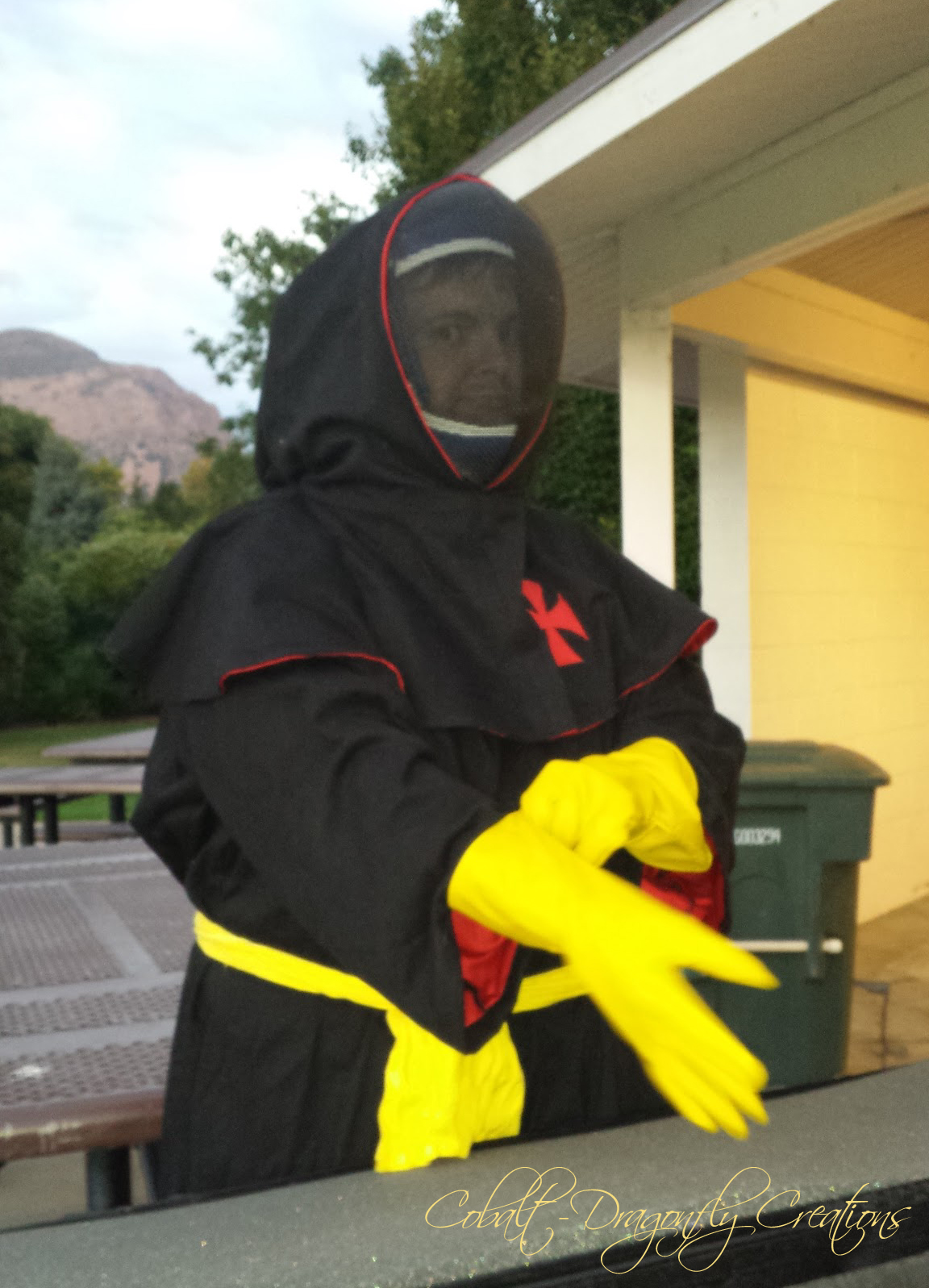
My dear Sven decided to take up rapier fighting, and needed armor that meets the safety requirements of the SCA. Rather than come up with a separate persona, he decided to maintain his Templar persona with a bit of appropriate anachronism, using this adorable image of fighting monks.

The robes are plain and simple, based on his regular Templar robes, with shortened length to avoid tripping. It's made of heavy black cotton twill, lined in heavy red cotton twill. He also wears two shirts underneath it, to ensure he has plenty of underarm coverage. The robes actually turned out a little too short, in retrospect. I suspect a second version will be forthcoming soon. The length issue is not one of safety, but one of aesthetics.


He now fights with cotton pants beneath rather than the tights, and his footwear varies depending on the fighting surface. His period boots have a serious lack of traction, which is something we're working on.

Fighting masks are required to have a back drape to protect the back of the head and neck. I decided to do a full hood over Sven's mask instead of a simple drape, to fit his persona. This is also heavy black twill lined in heavy red twill. It was tricky to sew onto the mask so the hood will never slide off his head, but the final product works very well, protects as needed, and looks really neat. I rolled the hood fabric a little when affixing it to the mask, to ensure the red lining would show. This also hides the white bib that is attached to the fencing mask. The Templar Cross is red linen appliqued into place.

Thursday, March 3, 2016

Persona Research Challenge - 2nd Prize

The second prize winner of the Artemisian Persona Research Challenge was m'lady Cheung Mei Wan for her article on Chinese hair ornaments.

She requested that her book have blank pages, and be bound in this lovely red brocade, which she provided to me. To bind books in fabric, you must use a process which will allow you to use glue on it without destroying the fabric itself. There are complicated ways of soaking the fabric in starch and paste, but I was afraid the Brocade would become water damaged from the pasting. It was also important to me to get this book done soon, as it's taken me longer to finish than I'd hoped. Life seems to get in the way of fun sometimes. I opted for a simple, quick and very not period method of backing the fabric with tissue paper using Heat 'n' Bond. I want to take the time to do testing on making book fabric "properly" in the future. 


This book is done in coptic stitch binding, which leaves the signatures visible on the spine, and shows a decorative stitch along the signatures. I did this using waxed cotton embroidery floss. It's a lot more wobbly than I'd prefer - clearly I need more practice. This book has 11 signatures.


The benefit to coptic stitch binding is that no glue is needed in attaching the covers to the body of the book, and books lay flat when open, which is great for writing and sketching. Incidentally, I'm supposed to be teaching a class on coptic stitch binding at Known World Heralds and Scribes Symposium next month. If you're there, come to my class or come say hi!


I used a heavy weight pearlescent paper with embossed floral designs for the inside of the covers. This reminded me of the papers used in the recipient's wedding bouquets, so I thought it would be a fun little personalized touch.


I finished the book off by adding metal corners to the outer edges. The inner edges could not be capped due to the binding stitches. I had some fraying problems with the fabric where the corners were turned in, so this helps keep everything tight where it should be. The glue used will keep the book from further fraying, but this looks much cleaner.

Friday, February 5, 2016

Persona Research Challenge - 1st Prize

My husband, Sven, is head of the Scholar's Guild in the Barony of Gryphon's Lair. With Their Majesties' support, he ran a Kingdom-wide Persona challenge wherein the entrants were to identify an art form that was used during their persona's timeline, and share five document-able facts about that art. This was the second challenge he's run.

He asked me if I would be willing to make prizes for the first and second place winners. Specifically, books! The idea was that the winners would work directly with me to indicate what kind of book they would want. 

Lord Cynric of Defnascir won first place with a well-written article on pattern welding. He wanted a book with lined paper, and chose the green goatskin leather from my stash for the cover. As this is the same goatskin I used for Master Aaron's vigil book, I did a few things to make this one different and unique.

Cynric wanted lined pages, so I created the lined paper with custom spacing and color (dark green), and printed it out double-sided on a high quality smooth finish paper. for making the signatures.
The spine has only two corded tabs rather than four, as on Aaron's book. This is still plenty secure, as I used four lengths of twine on each, rather than two. This makes the bump on the spine more pronounced (I like this look),, and gave me plenty of twine to work with when securing it to the bookboard.

His personal device sports a rampant horse, so I attached a silver horse pendant to the bookmark, giving it a bit of "Cynric flair."

This was the first time I've tried using metal corners. I fear they may fall off one day, but only time will tell. I adhered them to the corners using some PVA glue, and compressing the metal with pliers. I suspect such ornamentation in period would have been custom crafted and probably tacked in with nails or screws - I must do more research into this. While I'm very much enjoying bookbinding, I'm still quite new to it. This is only my fourth book, and my second of this size.

I'm well pleased with how the headbands turned out on this book. Headbands are designed to keep dust from getting down into the spine of the book. I bought a length of commercial headband that you trim to size and adhere into place on the spine prior to covering the book. One day I'll try my hand at making my own headband by sewing directly onto the spine.

The endpapers are a red linen textured paper chosen from my stash by Lord Cynric. Endpapers are usually a full signature in width, but in this case they are only half that.


Tuesday, January 19, 2016

Gryphon and Hammer Scroll

I was asked to produce a Gryphon and Hammer scroll for Asgierr Rekke I Dane (for whom I had to triple check the name spelling) which is our heavy fighting award in the Barony of Gryphon's Lair.

My first instinct was to do something with Norse flair, incorporating the valknut which has special meaning to the recipient. But knowing that his persona is Norse, I also knew that he'd likely receive a huge number of Norse-inspired pieces throughout his life playing in the SCA, so I went the other direction.

When I saw this piece from the Spiezer Chronik, 1484/85 Germany, I fell in love. I knew I had to do something based on it, and this was the perfect opportunity.

It featured tons of fun red fleuronee details (recipient loves red!), with blue acanthus (I love blue and acanthus!), and a stunning gold cadel. I did the cadel with brush rather than pen, and am reasonably happy with the way it turned out.

My version is on pergamenata with Winsor & Newton gouache, Finetec gold, and Pilot Iroshuzuki ink.


Wednesday, December 16, 2015

Happy Holidays!

To celebrate this holiday season, I'd like to share a manuscript page with you (click to enlarge).

Source: British Library, Add. 16997 f.57 Book of Hours, Use of Paris. 1st quarter of the 15th century

This page featuring the Adoration of the Child features beautiful floral motifs, brilliant colors, and acanthus details. I wish you all the very best of holidays, no matter how or with whom you choose to celebrate.

Lots of love,
Crystal / Jaquelinne

Wednesday, December 2, 2015

Master of the Laurel, Italian Style

Back in August, one of my Artemisian scribal heroes, HE Mistress Heloys de Bec, asked me if I would be willing to do a Laurel scroll for Sir Marcello da Donnici in an Italian style. Which of course, was a resounding yes.

I wanted this piece to scream "Late 15th Century Florence" without being a copy of one exact manuscript. I collected inspiration pieces which I shuffled and analyzed throughout the layout/sketching process. I found that this stretched my creative muscles a little more than usual, trying to aim for a specific style rather than a copy.

My inspiration pieces included:


Philostratus Flavius: Opera

Philostratus Flavius: Opera

Biblia dos Jeronimos

Philostratus Flavius: Opera and Bibilia do Jeronimos are are both often attributed to the talented Florentine master, Attavante Degli Attavanti, but the Philostratus Flavius: Opera is now agreed to have been Boccardino il Vecchio.


Another piece that inspired me was this, found online and attributed to Attavante Degli Attavanti, but sadly I cannot find the source of this page (and believe me, I've scoured my sources to try to find it!). It is said that Attavante did work for Matthias Corvinus of Hungary as he was building his magnificent library, the Bibliotheca Corviniana. The aforementioned Philostratus Flavius: Opera is from this library. Note: The book, Bibliotheca Corviniana indicates that this was indeed Attavante's work, and the manuscript is in the Vattican library. When I'm less swamped, I'll come back and edit this post to include that reference.

Typical motifs include a ton of acanthus, medallions featuring symbolism, jewels and pearls, and vibrant jewel tones. I chose to ignore the common theme of putti and/or cherubs.

The final piece included Sir Marcello's registered device, devices from his associated households, and elements of devices from those who have had a strong influence in his life, and of course several laurel wreaths.

Photos were taken after Her Majesty, Esther, had signed the scroll but before His Majesty, Ibrahim, had a chance to do so. Rest assured, this happened before it was awarded.


This piece is on Arches hot press using Winsor and Newton gouache, Finetec metallic pigments, and Pilot Ishirozuki ink. The calligraphy is a humanist hand, often found in Renaissance Italy.

If there is significant interest, I can put together an album of "in progress" pictures, showing the different stages of development this piece went though, and what order I worked in.

Thursday, July 16, 2015

Master of Defense Scroll

Several months ago, the lovely and talented Bethany of Windermere asked me to collaborate with her on one of Artemisia's Master of Defense premiers. The obvious answer was of course YES!

I was told that he wanted the piece to be based on this "Fechtbook." I'm afraid I know nothing about its source, so I just used this image when it came to doing the calligraphy.

I very quickly learned how incredibly a Roman hand is - Be it Trajan or New Roman. Everything must be uniform, straight, and clean. And all those serifs? They are a blasted nightmare. I don't think I've ever struggled with a hand the way I struggled to emanate this piece. Suffice it to say that I never got it quite to my preferred level of quality, but got it to a point that I hoped I wouldn't embarrass myself.

I actually like that the u's are v's, even though it can make reading it a bit difficult at times.


When I completed the calligraphy and decorative cadel swashy doodad (my favorite part of the piece), I passed it back to Bethany, who unfortunately had an explosion of life. She passed the piece over to the lovely Adele Blanked / Adeliz Fergusson who did the illumination. 


Wednesday, July 1, 2015

Vigil Book


Adventures in bookbinding! I must admit this is a new obsession for me. When His Excellency, Don Aaron Carter was included as one of the three Premier members of the Order of the Masters of Defense for Artemisia, I was thrilled. Aaron is an amazing man! My dear husband raised my hand for me, offering me to do his vigil book. I'm still really shy about this skill as I'm so new to it, but when he said yes, I did a happy dance.


Aaron's device is green and has wagon wheels on it, so I was not surprised when he asked for the book to be green. I managed to find some vintage wagon wheel buttons to incorporate into the design as well.

As I don't tool leather (...yet, she says cautiously), I was extremely happy to find a piece green goat skin suitable to bind the book.

The paper is a higher quality standard copy paper. 32lb, if I recall correctly, with a nice creamy texture. My quest to find a high quality paper that doesn't have annoying watermarks continues.

I hand folded the signatures, hand punched the binding holes, and hand stitched the signatures together with waxed linen thread.


My father made me a book press, which I then used to shape the spine into a curve. After that, I glued on a silk ribbon for a bookmark, headbands, and used cotton muslin as a spine cover thingy... I'm not sure the technical term for this bit is. Time to crack open my books again!

I then attached book board (an ugly, undocumented process), and carefully stretched the goat skin over the book board. Mid-way through this process, I sewed on the button, glued in a strap, and finished the cover with a deep sigh of relief that my strap/button plan worked.

The end papers are a white embossed pearlescent scrapbook paper that I decided were perfect based on the fact that Aaron's elevation garb was to be all white satin, dripping in pearls. A touch of foreshadowing, if you will.